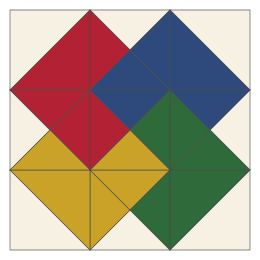
How the block is built
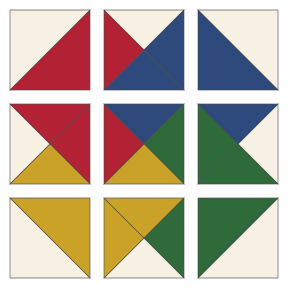
It's a 3 × 3 grid, with each unit a third of the block. Three kinds of unit:
- Four corner units, each a half-square triangle: background in the outer corner, one card color toward the center.
- Four side units, each made of a large triangle in one card color plus two small triangles, background on the outer edge and the other in a second card color.
- One center unit made of four small triangles, one of each card.
Follow one card around. The red card in the top-left is: the red half of the top-left corner, the small red triangle next to it in the top side unit, the large red triangle in the left side unit, and the red quarter of the center. Every card is the same shape, turned a quarter turn from the last.
Cutting chart (one block)
| Finished block | Unit | Background | Each of the 4 card fabrics | Unfinished block |
|---|---|---|---|---|
| 6 in | 2 in | 2 squares 2⅞ in, cut once; 1 square 3¼ in, cut twice | 1 square 2⅞ in, cut once; 1 square 3¼ in, cut twice | 6½ in |
| 9 in | 3 in | 2 squares 3⅞ in, cut once; 1 square 4¼ in, cut twice | 1 square 3⅞ in, cut once; 1 square 4¼ in, cut twice | 9½ in |
| 12 in | 4 in | 2 squares 4⅞ in, cut once; 1 square 5¼ in, cut twice | 1 square 4⅞ in, cut once; 1 square 5¼ in, cut twice | 12½ in |
"Cut once" means corner to corner on one diagonal, for two large triangles. "Cut twice" means on both diagonals, for four small triangles. The large-triangle squares are the unit + ⅞ inch and the small-triangle squares are the unit + 1¼ inches; both are exact sizes, with no extra to trim. Each card fabric gives two large triangles (one for a corner, one for a side unit) and four small ones, of which you use two; the other two are spare. The background gives four large triangles for the corners and four small ones for the side units. These counts and sizes were checked by calculation, and the pieces add up to exactly the nine units.
Cutting this way puts the straight grain on every outside edge of every unit: the large triangles have it on their short sides and the small ones on their long side. The cut edges inside the units are bias, so handle them gently and press without pushing the iron.
Piecing steps
- Lay out all the pieces on a board in block order before sewing anything. With four card colors this is the only reliable way to keep track.
- Corner units: sew each card's large triangle to a large background triangle along the long edge. Press toward the card. You have four HSTs, one per card.
- Side units: for the top side, sew a small background triangle to the small triangle of the top-left card along one short edge; together they make a larger triangle, with the background along what will be the block edge. Press toward the card. Then sew that pieced triangle to the large triangle of the top-right card along the long edge. Repeat for the other three sides, turning the pattern each time: the small card triangle always sits next to the corner it continues, and the large triangle belongs to the card of the next corner clockwise.
- Center: sew the four small card triangles into two pairs (top with right, bottom with left), then join the pairs across the middle like an hourglass. Pin at the center. Press the last seam open.
- Check every unit. Each should measure the unit + ½ inch (2½, 3½ or 4½ inches). Because the cuts are exact, a unit that's a little small points to a wide seam; ease it in rather than trimming everything else down.
- Sew the rows: corner, side, corner; side, center, side; corner, side, corner. Press the outer rows toward the corners and the middle row toward the center, then join the rows with the seams nested.
Choosing fabrics
The illusion depends on four clearly different card colors and a background that's lighter (or darker) than all of them. Medium-value prints that are close to each other turn the block into a muddle. Solids, tone-on-tones or small prints work best at 9 inches and below. Making every block with the same four colors gives a calm quilt; changing the set of four in every block makes a scrap quilt that still reads clearly, as long as each block's four are distinct.
Common mistakes and fixes
- A card looks cut in half. A side unit has its large triangle in the wrong card color. The large triangle in each side belongs to the next corner clockwise.
- Background shows in the middle. The center unit got a background triangle instead of a card triangle; the center is four card colors and no background.
- The outer edge stretches. The small triangles were cut once instead of twice, putting bias on the block edge. Cut the small-triangle squares on both diagonals.
- Points don't meet at the center. The center unit was trimmed unevenly or the triangles were sewn with an uneven seam. Pin at the center before joining its two halves.
Quilts made from card trick blocks
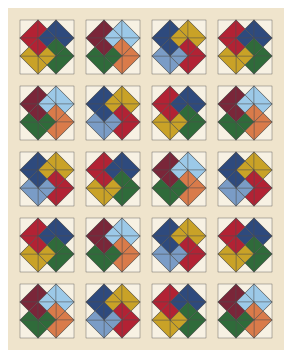
Sashing in a quiet color keeps each card trick separate, which suits a scrappy quilt. Without sashing, the background triangles of neighboring blocks meet and frame each block in a square on point, which looks good when the background is a strong solid. Because every block is a small puzzle, card trick is a popular block for guild swaps, where each person makes blocks in their own four colors.
Related blocks
The units in this block are covered one by one on the half-square triangle and hourglass pages; the half-square triangle calculator gives sizes for other units. Other nine-patch blocks with triangles: the Ohio star and the churn dash. For other block sizes see the block resizer, and for everything else the quilt block library.
You might also like
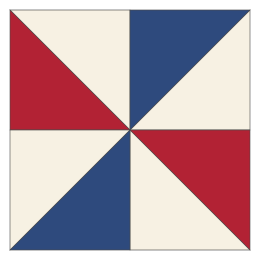 Pinwheel quilt blockFour half-square triangles turned around the center, cut for 4, 6, 8, 10 and 12 inch blocks.
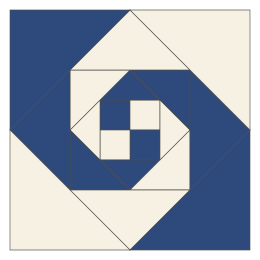 Snail's trail quilt blockA four-patch and four rounds of two-color triangles that spiral out, cut for 8, 12 and 16 inch blocks.
 Ohio star quilt blockAn eight-point star from quarter-square triangles, cut for 6, 9 and 12 inch blocks.
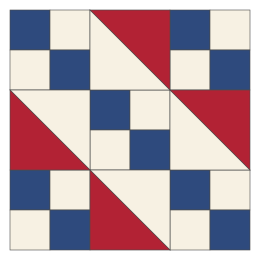 Jacob's ladder quilt blockFive four-patches and four triangle squares that link into diagonal ladders, cut for 6, 9 and 12 inch blocks.