How the sizes work
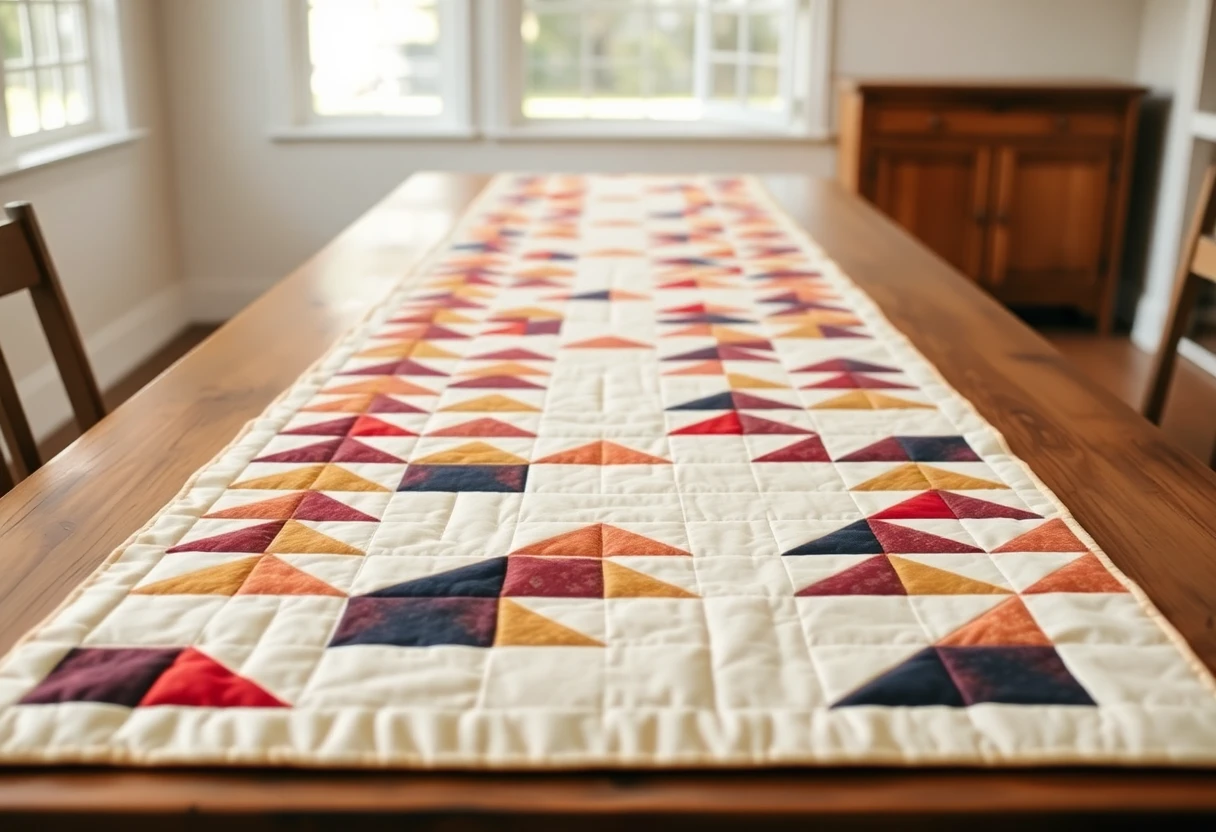
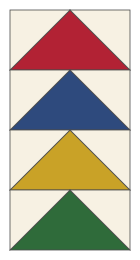
A goose is always twice as wide as it is tall. A "2 × 4" goose finishes 2 inches tall and 4 inches wide, and you trim it to 2½ × 4½ inches before sewing it to anything. The tip of the goose sits ¼ inch below the top raw edge, so it lands exactly on the seam line when the next unit is added. That ¼ inch is the whole game with geese: if the point is closer to the edge, it gets cut off by the next seam.
Method 1: one at a time (stitch and flip)
| Finished goose | Trim to | Goose rectangle | Sky squares (2 per goose) |
|---|---|---|---|
| 1 × 2 in | 1½ × 2½ in | 1½ × 2½ in | 1½ in |
| 1½ × 3 in | 2 × 3½ in | 2 × 3½ in | 2 in |
| 2 × 4 in | 2½ × 4½ in | 2½ × 4½ in | 2½ in |
| 3 × 6 in | 3½ × 6½ in | 3½ × 6½ in | 3½ in |
| 4 × 8 in | 4½ × 8½ in | 4½ × 8½ in | 4½ in |
The pieces are cut at the unfinished size, so nothing needs trimming if you sew accurately.
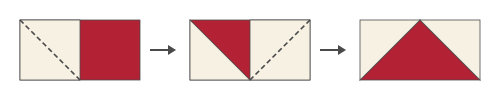
- Draw a diagonal line on the wrong side of each sky square.
- Lay a sky square on one end of the goose rectangle, right sides together, with the line running from the top inside corner of the square down to the bottom outer corner (see the diagram).
- Sew on the line, or a thread's width toward the corner. That tiny shift leaves room for the fold, so the pressed triangle reaches the corner instead of falling short.
- Trim ¼ inch beyond the stitching, cutting off the corner. Press the sky triangle open, seam toward the sky.
- Repeat on the other end with the line slanting the opposite way. The two lines should cross at the center of the top edge, ¼ inch down from the raw edge.
- Press, then check the size. Trim only if the unit is bigger than the unfinished size.
It wastes the two trimmed corners, which are already-sewn little HSTs if you sew a second line ½ inch outside the first before trimming. Save them for a mug rug or a doll quilt.
Method 2: four at a time (no waste)
| Finished goose | Large square (goose), exact | Small squares (sky), exact | Large, to trim | Small, to trim |
|---|---|---|---|---|
| 1 × 2 in | 3¼ in | 1⅞ in | 3½ in | 2 in |
| 1½ × 3 in | 4¼ in | 2⅜ in | 4½ in | 2½ in |
| 2 × 4 in | 5¼ in | 2⅞ in | 5½ in | 3 in |
| 3 × 6 in | 7¼ in | 3⅞ in | 7½ in | 4 in |
| 4 × 8 in | 9¼ in | 4⅞ in | 9½ in | 5 in |
The rule: large square = finished width + 1¼ inches, small squares = finished height + ⅞ inch. Add ¼ inch to the large square and ⅛ inch to the small ones if you'd rather trim. Each set of one large and four small squares makes four geese.
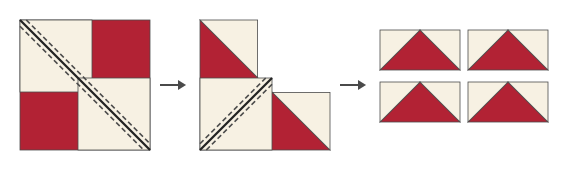
- Draw a diagonal line on the wrong side of the four small squares.
- Lay two small squares on opposite corners of the large square, right sides together, so their lines form one continuous diagonal. They overlap a little in the middle; that's correct.
- Sew ¼ inch from the line on both sides. Cut on the line.
- Press the small triangles open, away from the large one. Each piece now looks like a heart.
- Lay a third small square in the remaining goose-fabric corner of each heart, with its line running from that corner to the point between the two sky triangles.
- Sew ¼ inch on both sides of the line, cut on the line and press the sky open. Each heart gives two geese, four in all.
- If you cut the larger sizes, trim each goose to the unfinished size, keeping the tip centered and ¼ inch below the top edge.
Our patriotic star throw uses this method with 7¼-inch and 3⅞-inch squares for 80 geese, and the Christmas star table runner uses the same squares for its three stars.
Which method to use
For a first batch, use stitch-and-flip. It's more forgiving, because the pieces are cut at the finished size plus seams and the goose rectangle keeps every edge on the straight grain. It uses more fabric. The no-waste method is faster and thriftier once you have a batch to make, and both star patterns on this site use it. It's less forgiving of a wobbly seam, so cut the trim sizes the first time.
Pressing
In stitch-and-flip, press the sky triangles toward the sky. In the no-waste method, press toward the small triangles at both stages. When you join geese into a column, press the seams toward the base of each goose (away from the tip) so the point isn't buried in bulk. Some quilters press these seams open instead, which also works and lies flatter in a long column.
Sewing geese together without losing the points
Sew geese into a column with the goose you're adding on the bottom and the one with the visible point on top. That way you can see the X where the seams cross at the tip. Sew a thread's width above it, through the X, and the point survives.
Common mistakes and fixes
| Problem | Cause | Fix |
|---|---|---|
| Point cut off when the next unit is added | Tip closer than ¼ inch to the edge | Trim with the tip centered and ¼ inch down; sew through the X |
| Sky triangle doesn't reach the corner | Stitching exactly on the line, so the fold takes up fabric | Sew a thread's width toward the corner |
| Both sky lines slant the same way | Second square rotated wrong | The lines should form a V that meets at the top center |
| No-waste geese too small | Squares cut at the exact size and seams a little wide | Cut the trim sizes; check your ¼-inch seam |
| Wobbly, stretched geese | Pressing with a sliding iron on bias edges | Lift and press; starch before cutting |
Quilts made from flying geese
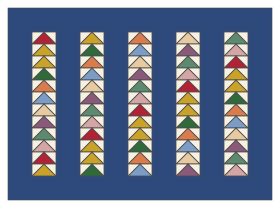
Columns of geese between plain strips eat scraps, since every goose can be a different print. Four geese around a center square make a sawtooth star. Geese pointing around a quilt in a border make it look like the whole quilt is moving.
The goose is one of three units most blocks are built from. The other two are the half-square triangle and the quarter-square triangle used in the hourglass and the Ohio star. The stitch-and-flip corner trick from Method 1 is also how the knot is made in the bow tie block.
You might also like
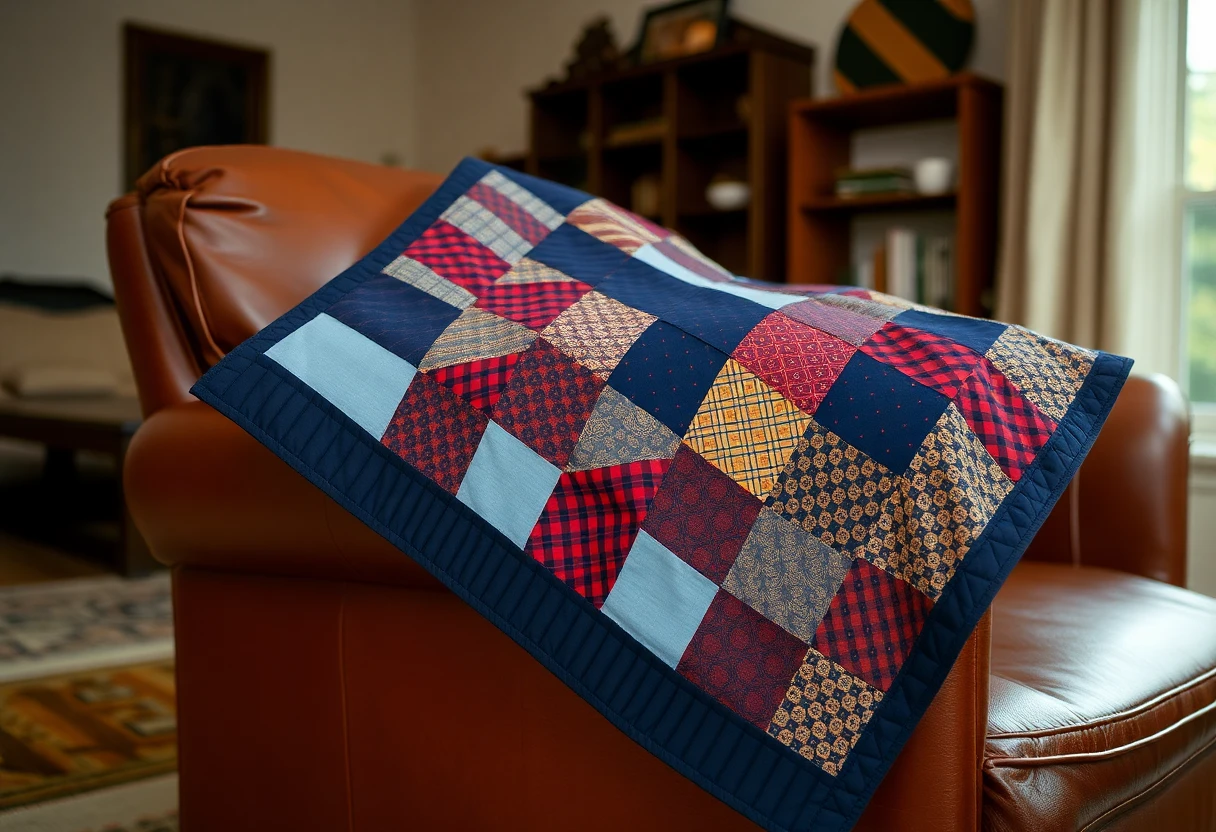 Bow tie quilt blockA four-patch with stitch-and-flip corners, cut for four sizes, and how to use neckties.
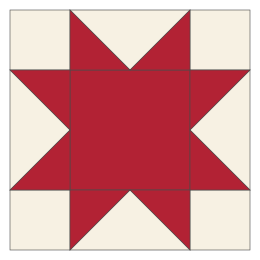 Sawtooth star quilt blockA big center square and four flying geese points, cut for 6, 8, 12 and 16 inch blocks.
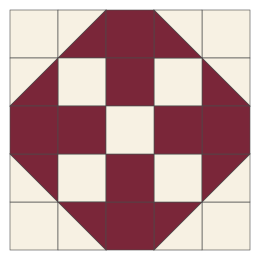 Sister's choice quilt blockA five-patch with a nine-patch center and eight triangle points, cut for four sizes.
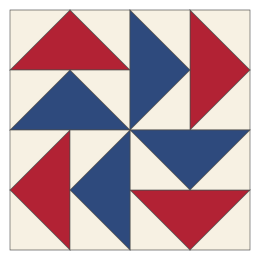 Dutchman's puzzle quilt blockEight flying geese in pairs turning around the center, cut for 6, 8, 12 and 16 inch blocks.