Calculator
Turn on JavaScript to use the calculator, or use the charts below.

How the numbers work
The center sits on point, so its side is the block’s finished size F divided by 1.414 (the square root of 2). Each corner triangle has short sides of half the block, F/2. Seam allowances go on top of those.
| Piece | Exact cut | Cut to trim | Per block |
|---|---|---|---|
| Center square | F ÷ 1.414 + ½ in, rounded up to the next ⅛ | same | 1 |
| Corner squares, cut once on the diagonal | F/2 + ⅞ in | F/2 + 1¼ in | 2 (4 triangles) |
| Or one square, cut twice on the diagonal | F ÷ 1.414 + 1¼ in | F ÷ 1.414 + 1½ in | 1 (4 triangles) |
| Stitch and flip: base square | F + ½ in | 1 | |
| Stitch and flip: corner squares | F/2 + ½ in | 4 |
Trim the block to F + ½ inch, keeping a quarter inch beyond each point of the center. The center is the one piece you shouldn’t oversize: if it is too big, its points run into the seam allowance and get cut off when you trim. The corners are where extra fabric helps.
For the economy block, the inner square in a square finishes at F ÷ 1.414, and the center at exactly half the block. That gives a clean center cut of F/2 + ½ inch. The first-round corners come from squares of F ÷ 2.828 + ⅞ inch (rounded up). The second round uses the same F/2 + ⅞ inch squares as a single square in a square.
Common sizes
Square in a square, exact cuts:
| Finished block | Center square | Corner squares, cut once (2) | Or one square, cut twice | Trim block to |
|---|---|---|---|---|
| 2 in | 2 in | 1⅞ in | 2¾ in | 2½ in |
| 3 in | 2⅝ in | 2⅜ in | 3⅜ in | 3½ in |
| 4 in | 3⅜ in | 2⅞ in | 4⅛ in | 4½ in |
| 5 in | 4⅛ in | 3⅜ in | 4⅞ in | 5½ in |
| 6 in | 4¾ in | 3⅞ in | 5½ in | 6½ in |
| 8 in | 6¼ in | 4⅞ in | 7 in | 8½ in |
| 9 in | 6⅞ in | 5⅜ in | 7⅝ in | 9½ in |
| 10 in | 7⅝ in | 5⅞ in | 8⅜ in | 10½ in |
| 12 in | 9 in | 6⅞ in | 9¾ in | 12½ in |
Economy block, exact cuts (cut the round 1 squares an eighth to a quarter inch larger if you plan to trim):
| Finished block | Center square | Round 1 squares, cut once (2) | Round 2 squares, cut once (2) |
|---|---|---|---|
| 4 in | 2½ in | 2⅜ in | 2⅞ in |
| 6 in | 3½ in | 3 in | 3⅞ in |
| 8 in | 4½ in | 3¾ in | 4⅞ in |
| 10 in | 5½ in | 4½ in | 5⅞ in |
| 12 in | 6½ in | 5⅛ in | 6⅞ in |
Which corner method to use
Squares cut once on the diagonal are the usual choice. Each triangle has straight grain on its two short sides, and those become the outside edges of the block, so the block holds its shape when it’s sewn to its neighbors.
One square cut twice gives all four triangles from a single square, which is handy for scraps. The catch is the grain: the straight grain ends up on the long side, against the center, and the outside edges of the block are bias. Use it for blocks that get sashing or are sewn soon after, and handle them by the center.
Stitch and flip skips triangles altogether. Draw a diagonal on four small squares, lay one on each corner of a big square, right sides together, with the line running across the corner, sew on the line, trim a quarter inch outside the line and press. It is easy to get accurate on small blocks, and it wastes the most fabric: the trimmed corners are two layers of triangle. Sew a second line half an inch outside the first and you get a bonus half-square triangle from each corner.
Sewing tips
- Fold the center square and each triangle in half and finger-press a crease at the middle of the long edge. Match the creases and the triangle sits centered, with its tips hanging past the square by the same amount at each end.
- Sew two opposite corners first, press, then the other two.
- Press the seams toward the corners, away from the center.
- For an economy block, trim the first round a quarter inch beyond the points before adding round 2. Its size isn’t an even fraction, so trust the points, not a ruler line.
Related tools and blocks
Square-in-a-square units are the centers of many star blocks; the Ohio star and hourglass block are close relatives. For half-square and quarter-square triangle cuts, see the half-square triangle calculator. Economy blocks look striking set on point; the setting triangle calculator handles the edges, and the sashing calculator spaces them out.
You might also like
 Setting triangle calculator for on-point quiltsSide and corner triangle cuts, counts and finished size for blocks set on point.
 Half-square triangle calculatorCut sizes for half-square triangles, hourglass units and flying geese, by method.
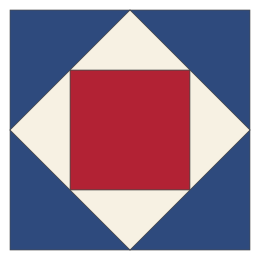 Economy quilt block (square in a square)A center square framed by two rounds of triangles, with cut sizes for 4, 6, 8 and 12 inch blocks.
 Half-rectangle triangle calculatorCut rectangles and tip offset for half-rectangle triangles, with a printable chart.